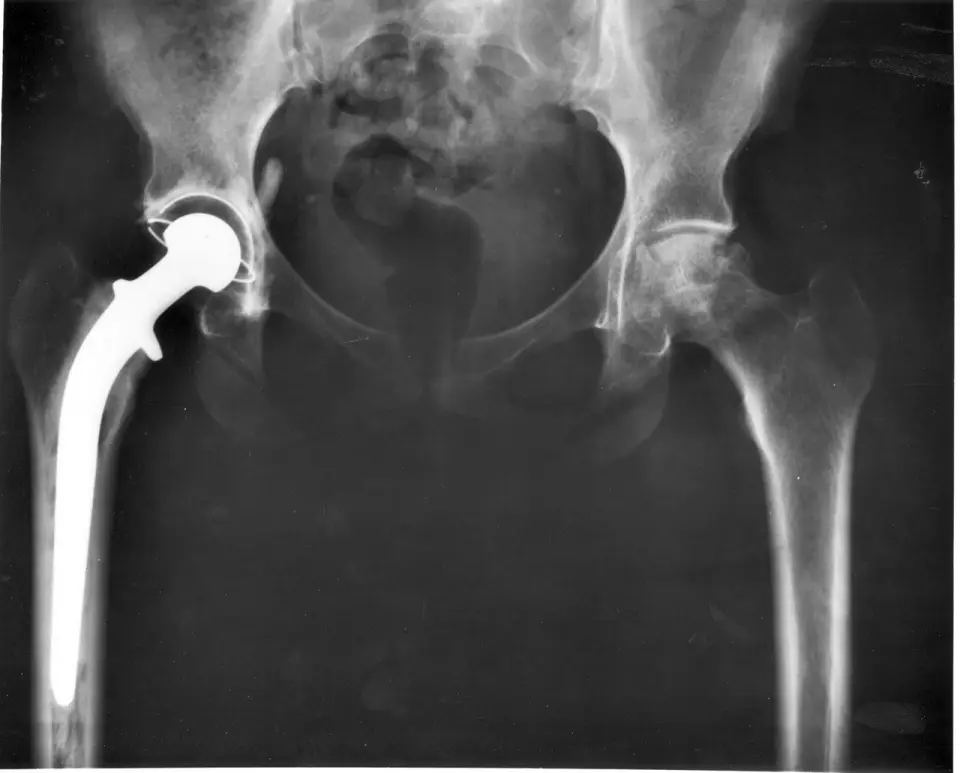
Harris Hip Score and SF-36 following metal-on-metal total hip arthroplasty and hip resurfacing - a randomized controlled trial with 5-years follow up including 75 patients
CirurgiaPor ScienceMed · · a partir do resumo dos autores
Resumo original em inglês
O que aconteceu
The metal-on-metal large-diameter-head (MoM-LDH) hip replacements increased in popularity during the start of the twenty-first century. Subsequently reports raised concerns regarding adverse reactions due to elevated chromium (Cr) and cobalt (Co) concentrations as well as high rates of other complications and revisions. The purpose was to compare Harris Hip Score and SF-36 at 5-years follow up following MoM-LDH total hip arthroplasty (MoM-LDH-THA) or MoM hip resurfacing (MoM-HR).
The study was conducted between November 2006 to January 2012 in a tertiary health care center in Denmark. Patients with primary or secondary osteoarthritis were randomly assigned to receive a Magnum (MoM-LDH-THA) or a Recap (MoM-HR) prosthesis. Randomization was computer generated and allocation was concealed in an opaque envelope. Neither patients nor care provider were blinded. Primary outcome was Harris Hip Score at 5-years follow up.
ClinicalTrials.gov, NCT04585022 , Registered 23 September 2020 - Retrospectively registered. This study was not prospectively registered in a clinical trial database since it was not an entirely implemented standard procedure in the international orthopedic society when the study was planned.
O que encontraram
Seventy-five were included and allocated to the MoM-LDH-THA (n = 39) and MoM-HR (n = 36) group. The study was prematurely stopped due to numerous reports of adverse events in patients with MoM hip replacements. Thirty-three in the MoM-LDH-THA and 25 in the MoM-HR group were available for primary outcome analysis. Median Harris Hip Score was 100 (IQR: 98-100) for MoM-LDH-THA and 100 (IQR: 93-100) for MoM-HR (p = 0.486). SF-36 score was high in both groups with no significant difference between groups.
Por que isso importa
Harris Hip Score and SF-36 score was excellent in both groups with no significant difference at 5-years follow up. Our findings suggest that there is no clinical important difference between the two prostheses implanted 5 years after implantation.
Resumo publicado sob licença CC BY. A tradução para o português ainda não chegou a este estudo.
O estudo original
Harris Hip Score and SF-36 following metal-on-metal total hip arthroplasty and hip resurfacing - a randomized controlled trial with 5-years follow up including 75 patients
Peter Nyby Hersnaes, Kirill Gromov, Kristian Stahl Otte, Peter Henrik Gebuhr, Anders Troelsen
Descritores MeSH
- Hip Prosthesis
- Arthroplasty, Replacement, Hip
- Metal-on-Metal Joint Prostheses
- Humans
- Chromium
- Prosthesis Failure
- Reoperation
- Prosthesis Design
- Cobalt
- Follow-Up Studies
Veja também
Estudos relacionados
- Hip Resurfacing Arthroplasty Is Associated with Lower Metal Ion Levels and Revision Risk Compared with Large-Head Metal-on-Metal Total Hip Arthroplasty: A Systematic Review and Meta-Analysis
- Minimum five years outcomes of modular dual mobility in primary total hip arthroplasty: a systematic review
- Cemented and cementless dual mobility cups show similar fixation, low polyethylene wear, and low serum cobalt-chromium in elderly patients: a randomized radiostereometry study with 6 years' follow-up
- Despite higher revision rate, MoM large-head THA offers better clinical scores than HR: 14-year results from a randomized controlled trial involving 48 patients