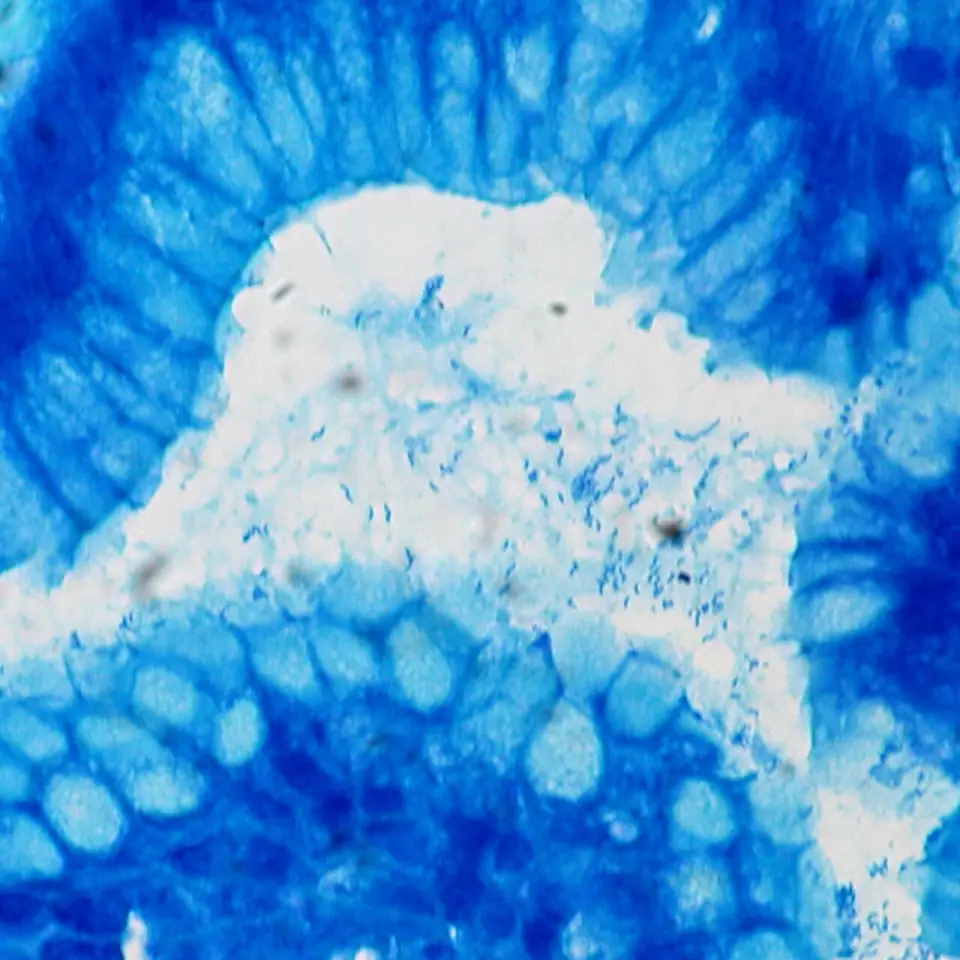
Terapêutica quádrupla baseada em anaprazol versus rabeprazol para erradicação de Helicobacter pylori: um ensaio controlado prospectivo, multicêntrico e randomizado
InfectologiaResumo original em inglês
O que aconteceu
To compare the efficacy and safety of a bismuth-containing quadruple therapy comprising the novel proton pump inhibitor (PPI) anaprazole versus the classical PPI rabeprazole, both combined with amoxicillin and furazolidone, for Helicobacter pylori (H. pylori) eradication.
A prospective, multicenter, randomized, open-label, non-inferiority design was employed. Consecutive treatment-naïve patients positive for H. pylori who visited the gastroenterology departments of four hospitals in Jiangsu Province between August 2025 and February 2026 were enrolled. Eligible patients were randomly assigned in a 1:1 ratio to two groups: the anaprazole group (anaprazole 20 mg, amoxicillin 1000 mg, furazolidone 100 mg, and colloidal bismuth pectin 300 mg, twice daily) and the rabeprazole group (rabeprazole 20 mg, amoxicillin 1000 mg, furazolidone 100 mg, and colloidal bismuth pectin 300 mg, twice daily). Both groups received a 14-day treatment course. H. pylori eradication was assessed by ¹³C-urea breath test at 4 weeks after the completion of therapy.
O que encontraram
A total of 320 patients were enrolled, with 160 in each group. In the intention-to-treat (ITT) analysis, the eradication rate was 81.9% (95% CI: 75.2% to 87.1%) in the anaprazole group and 80.0% (95% CI: 73.1% to 85.5%) in the rabeprazole group, with a difference of 1.9% (95% CI: -6.7% to 10.5%, P=0.67). In the modified intention-to-treat (mITT) analysis, the eradication rates were 89.1% (95% CI: 83.1% to 93.2%) and 88.9% (95% CI: 82.7% to 93.1%), respectively (difference: 0.2%; 95% CI: -7.0% to 7.4%, P=0.95). In the per-protocol (PP) analysis, the eradication rates were 90.9% (95% CI: 85.2% to 94.6%) and 90.0% (95% CI: 83.9% to 94.0%), respectively (difference: 0.9%; 95% CI: -5.8% to 7.6%, P=0.80). Regarding safety, the incidence of adverse events was slightly higher in the anaprazole group compared to the rabeprazole group (22.50% vs. 15.00%), but the difference was not statistically significant (P=0.09). Medication adherence was similar between the two groups (P=0.60).
Por que isso importa
The quadruple regimen consisting of anaprazole combined with amoxicillin, furazolidone, and bismuth is non-inferior to the rabeprazole-based quadruple regimen for the eradication of H. pylori infection. There were no significant differences between the two groups in terms of eradication rate, incidence of adverse reactions, or medication adherence. Anaprazole, as an acid-suppressive agent, achieves satisfactory efficacy in H. pylori eradication therapy and holds promise for clinical application.
Resumo publicado sob licença CC BY. A tradução para o português ainda não chegou a este estudo.
O estudo original
Anaprazole-based versus rabeprazole-based quadruple therapy for Helicobacter pylori eradication: a prospective, multicenter, randomized controlled trial
Xiujuan Wang, Haocheng Wang, Yan Wang, Lu Shen, Guiqin Li, Jijun Zhu, Changhui Li, Jiahuan Gao, Zhenyu Zhang
Descritores MeSH
- Helicobacter pylori
- Helicobacter Infections
- Anti-Bacterial Agents
- Proton Pump Inhibitors
- Rabeprazole
- Drug Therapy, Combination
- Female
- Furazolidone
- Adult
- Male