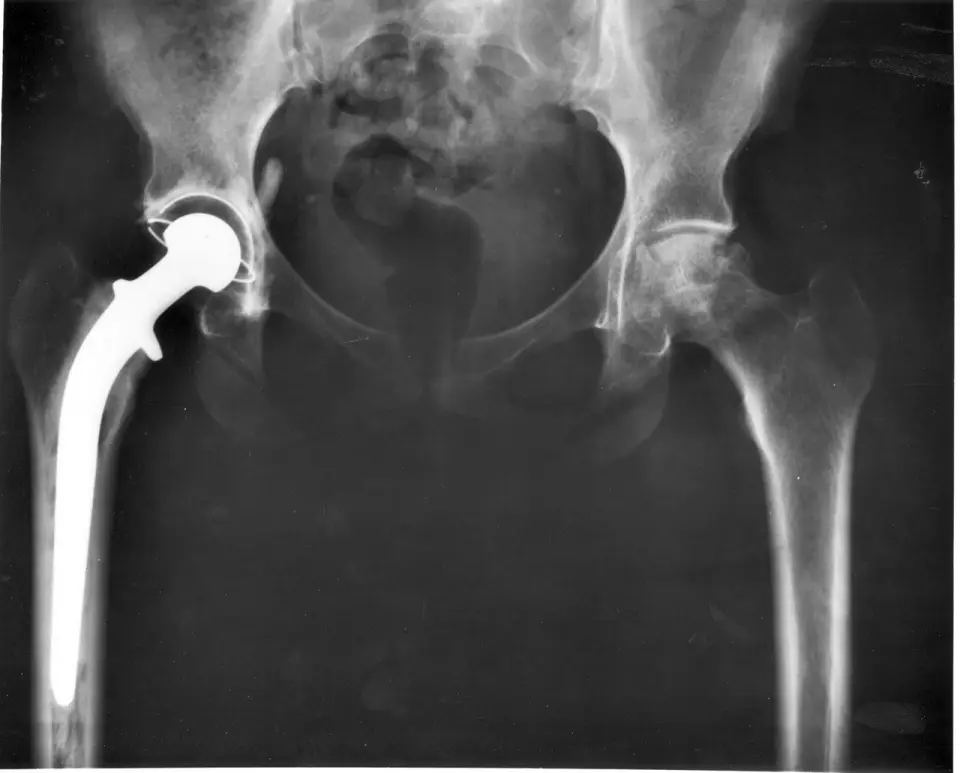
Surgical complications and periprosthetic fractures following femoral impaction grafting in revision hip arthroplasty: a systematic review and meta-analysis of 4686 hips
OrtopediaPor ScienceMed · · a partir do resumo dos autores
Resumo original em inglês
O que aconteceu
To evaluate the incidence of surgical complications, particularly periprosthetic fractures, following femoral impaction bone grafting (fIBG) in revision total hip arthroplasty (rTHA).
This systematic review followed PRISMA guidelines. Studies reporting on fIBG in rTHA with a minimum follow-up of 12 months were included. Risk of bias was assessed using the Methodological Index for Non-Randomised Studies (MINORS). A random-effects meta-analysis with inverse-variance weighting was performed. Heterogeneity was assessed using Higgins and Thompson's I2 statistic and Cochran's Q test. Subgroup analyses were conducted based on patient characteristics, revision indication, follow-up period, bone loss severity, stem length, and cementation. Complications requiring intervention, as well as nerve lesions with partial or no recovery, were classified as major.
O que encontraram
Forty-five studies including 4,686 hips (4,409 patients) were analyzed. The pooled incidence of major complications was 21% (n = 730; 95% CI 16-26%; I2 = 89%, p < 0.01). Of these, 78% required surgical intervention. The most common major complications were intraoperative fractures (22.7%), postoperative fractures (19.3%), and instability (19.2%). Higher complication rates were reported with long stems (44.1%) compared with short stems (18.8%, p = 0.016) and in cases of severe bone loss (Endo-Klinik grades III/IV, 25.3%) compared with I/II (14.2%, p = 0.028).
Por que isso importa
Major complications following fIBG in rTHA are relatively frequent, although interpretation is limited by substantial study heterogeneity. Higher complication rates were observed in cases with severe bone loss and the use of long stems, likely reflecting greater surgical complexity.
Resumo publicado sob licença CC BY. A tradução para o português ainda não chegou a este estudo.
O estudo original
Surgical complications and periprosthetic fractures following femoral impaction grafting in revision hip arthroplasty: a systematic review and meta-analysis of 4686 hips
Octavian Andronic, Rutenis Badikonis, Artsiom Klimko, Victor Yan Zhe Lu, Armando Hoch, Patrick O Zingg
Descritores MeSH
- Femur
- Postoperative Complications
- Bone Transplantation
- Arthroplasty, Replacement, Hip
- Periprosthetic Fractures
- Hip Prosthesis
- Humans
- Incidence
- Reoperation
Veja também
Estudos relacionados
- A Incidência de Fraturas Femorais Periprotéticas Late por Revisão Sistemática Tipo A de Implante e Meta-Análise
- Intraoperative acetabular periprosthetic fracture (IAPF) in total hip arthroplasty: a systematic review of outcomes and complications in conservative and surgical treatment
- Graft incorporation and stem subsidence in femoral impaction bone grafting for revision hip arthroplasty: a systematic review and meta-analysis of 2514 hips
- Association between cemented femoral stem design and unfavorable postoperative outcomes in hip fracture patients: A systematic review and meta-analysis