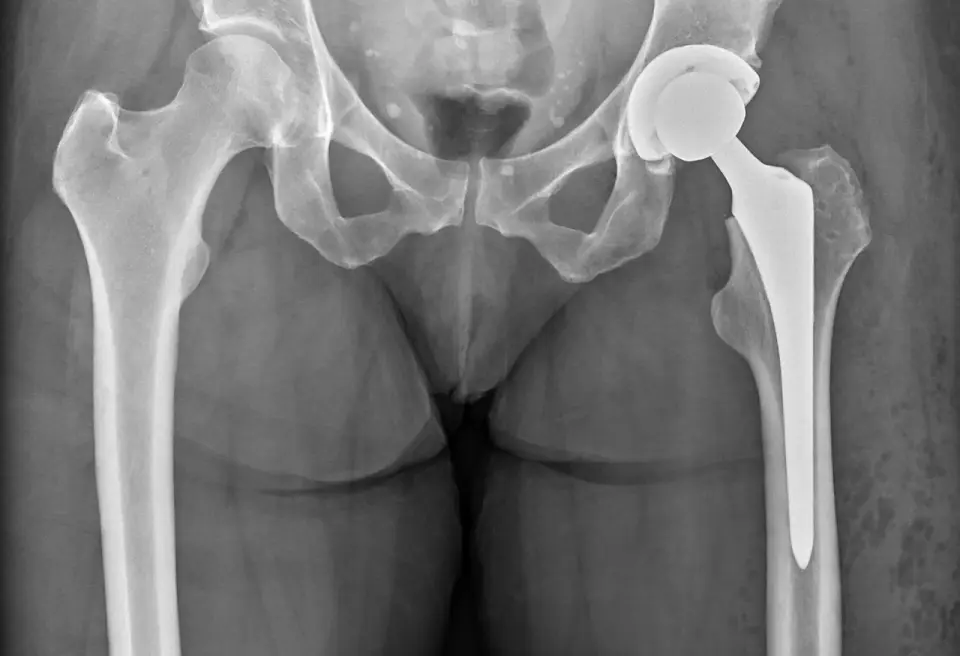
Revision for dislocation and all-causes following primary total hip replacement using 36-mm versus 32-mm femoral heads on polyethylene liners: a systematic review and meta-analysis
OrtopediaPor ScienceMed · · a partir do resumo dos autores
Resumo original em inglês
O que aconteceu
INTRODUCTION: The use of a 36-mm femoral head in primary total hip replacement (THR) increases the jump distance and offers a wider impingement-free range of motion, theoretically reducing the risk of post-operative dislocation. However, concerns exist regarding its potentially greater impact on polyethylene wear and associated risks of liner fracture, aseptic loosening, and head-neck taper corrosion, compared to 32-mm femoral heads. This meta-analysis aims to compare the risk of revision for dislocation and all-causes when using 36-mm versus 32-mm metal or ceramic femoral heads with polyethylene liners for primary THR. METHODS: Medline, Embase, Web of Science, and the Cochrane Library were searched for relevant studies, while annual reports of arthroplasty registries were searched for relevant data. Random effects meta-analysis was performed. Sensitivity analysis was conducted, limiting to THR performed for osteoarthritis and using cross-linked polyethylene liners, or statistically adjusting for this factor. The study was registered in the International Prospective Register of Systematic Reviews (PROSPERO ID CRD42024557895). RESULTS: Four observational studies and two registry reports were identified. Median follow-up ranged from 2.1 to 4.7 years (inter-quartile range values spanned from 0.9 to 7.7 years). The main analyses demonstrated that 36-mm heads were associated with a marginal reduction in the risk of revision for dislocation (HR 0.85, 95%CI 0.72–1.01, p = 0.058; n = 241,136) without an increased risk of all-cause revision (HR 1.06, 95%CI 0.95–1.18, p = 0.287; n = 942,617). Similar results were observed in the sensitivity analyses. DISCUSSION: At early to midterm follow-up, the use of 36-mm heads were not associated with an increased risk of revision for all-causes, compared to 32-mm heads. However, they may offer a protective reduction against revision for dislocation, as a marginal statistically significant reduction was observed, indicating a possible benefit. Further studies investigating these outcomes at longer-term follow up are needed to understand whether these revision risk profiles are maintained.
Resumo publicado sob licença CC BY. A tradução para o português ainda não chegou a este estudo.
O estudo original
Revision for dislocation and all-causes following primary total hip replacement using 36-mm versus 32-mm femoral heads on polyethylene liners: a systematic review and meta-analysis
Muhamed M Farhan-Alanie, Mina Abdul-Hussein, Daniel Gallacher, Prakrit R Kumar, Rajpreet Sahemey, Peter D H Wall, Michael Blankstein
Descritores MeSH
- Hip Prosthesis
- Reoperation
- Arthroplasty, Replacement, Hip
- Hip Dislocation
- Postoperative Complications
- Prosthesis Design
- Polyethylene
- Humans
- Prosthesis Failure
- Femur Head
Veja também
Estudos relacionados
- Dual Mobility vs. Large Femoral Head (≥36 mm) in Primary and Revision Total Hip Arthroplasty: A Meta-Analysis of Outcomes
- The addition of vitamin E could reduce femoral head penetration of the polyethylene liners
- Modular versus monobloc dual mobility components for primary cementless total hip arthroplasty: a systematic review and meta-analysis of implants' survival, complication rates, clinical and radiographic outcomes
- Dual-mobility constructs versus large femoral head bearings in primary and revision total hip arthroplasty: a systematic review and meta-analysis of comparative studies