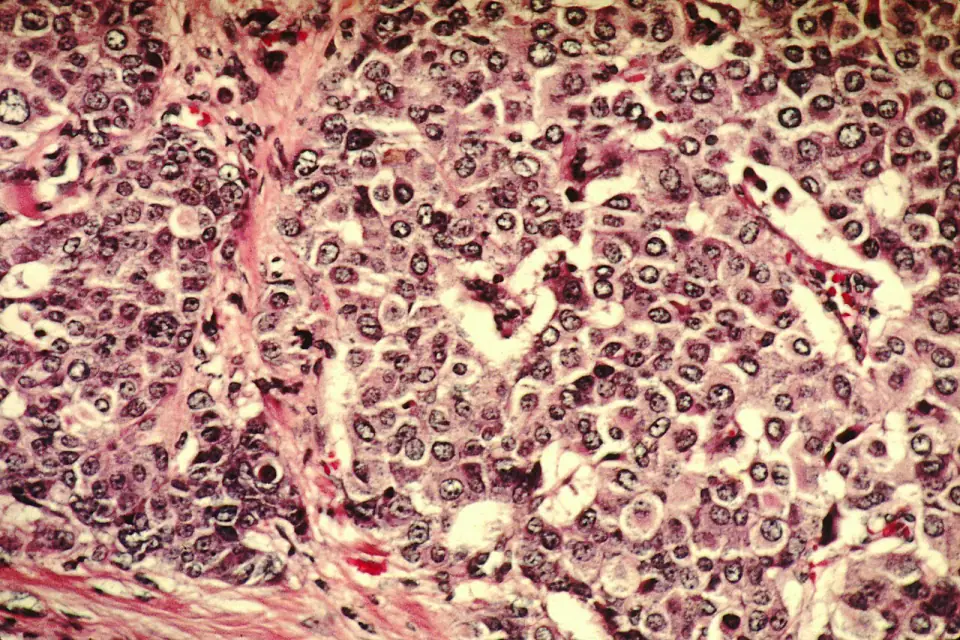
RAD51 Testing in Patients with Early HER2-Negative Breast Cancer and Homologous Recombination Deficiency: A Post Hoc Analysis of the GeparOLA Trial
OncologiaPor ScienceMed · · a partir dos dados do estudo
Sobre o estudo
- Desenho
- Ensaio clínico randomizado
- Nível de evidência
- 2 · Nova evidência
- Revista
- Clinical cancer research : an official journal of the American Association for Cancer Research
- Publicado em
- 3 mar 2025
- Citações
- 8
O resumo deste estudo é do publisher e não tem licença aberta: por isso mostramos aqui só os dados do estudo, e o texto fica na fonte original, nos links abaixo.
O estudo original
RAD51 Testing in Patients with Early HER2-Negative Breast Cancer and Homologous Recombination Deficiency: A Post Hoc Analysis of the GeparOLA Trial
Guillermo Villacampa, Alba Llop-Guevara, Natalie Filmann, Andrea Herencia-Ropero, Peter A Fasching, Thomas Karn, Frederik Marmé, Peter Klare, Volkmar Müller, Andrea Stefek et al.
Descritores MeSH
- Erb-b2 Receptor Tyrosine Kinases
- Breast Neoplasms
- Antineoplastic Combined Chemotherapy Protocols
- Rad51 Recombinase
- Homologous Recombination
- Mutation
- Neoplasm Staging
- Phthalazines
- Adult
- Biomarkers, Tumor
Veja também
Estudos relacionados
- Neoadjuvant Paclitaxel/Olaparib in Comparison to Paclitaxel/Carboplatin in Patients with HER2-Negative Breast Cancer and HRD-Long-term Survival of the GeparOLA Study
- Targeting homologous recombination deficiency with intensified chemotherapy versus standard chemotherapy followed by olaparib in stage III breast cancer (SUBITO): an open-label, randomised, controlled, phase 3 trial
- Durvalumab with carboplatin/paclitaxel and bevacizumab followed by durvalumab and bevacizumab with or without olaparib maintenance in newly diagnosed non-BRCA-mutated advanced ovarian cancer
- Neoadjuvant PARP inhibitor scheduling in BRCA1 and BRCA2 related breast cancer: PARTNER, a randomized phase II/III trial