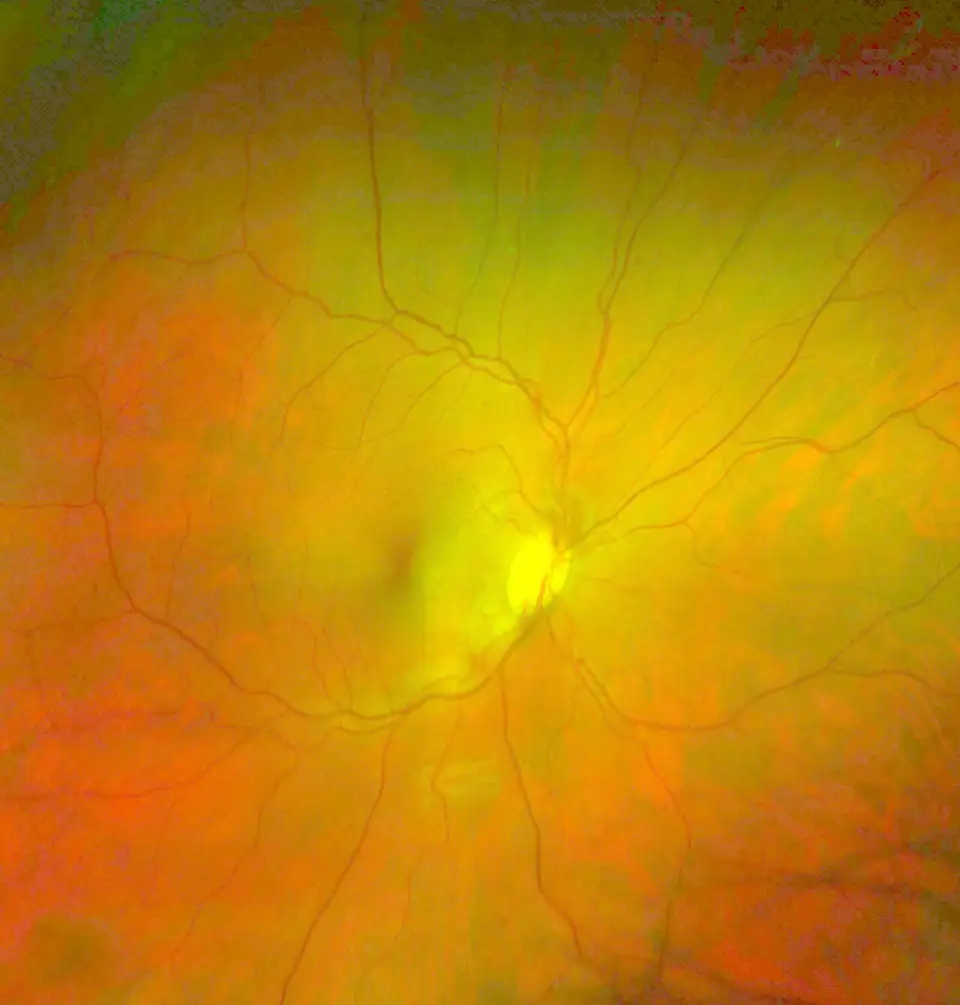
Predictors of Visual Acuity Outcomes after Anti-Vascular Endothelial Growth Factor Treatment for Macular Edema Secondary to Central Retinal Vein Occlusion
OftalmologiaPor ScienceMed · · a partir do resumo dos autores
Resumo original em inglês
O que aconteceu
To evaluate whether baseline demographic, clinical, and OCT characteristics predict visual acuity (VA) outcomes in patients receiving anti-vascular endothelial growth factor (VEGF) therapy for macular edema (ME) due to central retinal vein occlusion (CRVO).
Post hoc analysis of the randomized noninferiority trial (Lucentis, Eylea, Avastin in CRVO) LEAVO Study from December 12, 2014, to December 16, 2016, carried out across 44 UK National Health Service ophthalmology departments.
Data on 267 participants with a baseline best-corrected mean visual acuity (BCVA) range of 19 to 78 Early Treatment Diabetic Retinopathy Study letter score (approximate Snellen equivalent, 20/32 to 20/320) who had central subfield thickness (CST) ≥ 320 μm on Spectralis OCT (Heidelberg Engineering) were analyzed.
Study participants were randomized to receive repeated intravitreal injections of ranibizumab (0.5 mg/50 μl), aflibercept (2.0 mg/50 μl), or bevacizumab (1.25 mg/50 μl), and a protocol-driven pro re nata re-treatment regimen at 4 to 8 weekly visits was followed up to week 100 after 4 mandated 4-weekly loading injections.
O que encontraram
Change in BCVA and percentage of patients gaining ≥ 10 letters and achieving BCVA letter score > 70 letters at 52 and 100 weeks.
The analysis was adjusted for treatment effects and confirmed by sensitivity analysis. Age ≥ 75 years is a poor predictor for all 3 visual outcomes. Lower baseline BCVA predicted 10-letter gainers and higher gains in BCVA, although it is a poor predictor of achieving > 70 Early Treatment Diabetic Retinopathy Study letters. None of the baseline OCT morphologic characteristics except ellipsoid zone (EZ) integrity influenced any visual outcomes. Both baseline CST and total macular volume showed a nonlinear relation to 10-letter gainers, with CST > 900 μm being a poor prognostic indicator. Baseline CST and macular volume did not predict mean change in BCVA or BCVA > 70 letters at 52 and 100 weeks. The sensitivity analysis conclusions after removing iCRVO were similar.
Por que isso importa
At presentation, younger age, higher baseline BCVA, and a definitely intact subfoveal EZ are predictors of BCVA score > 70 letters at 100 weeks.
Resumo publicado sob licença CC BY. A tradução para o português ainda não chegou a este estudo.
O estudo original
Predictors of Visual Acuity Outcomes after Anti-Vascular Endothelial Growth Factor Treatment for Macular Edema Secondary to Central Retinal Vein Occlusion
Piyali Sen, Sarega Gurudas, Jayashree Ramu, Namritha Patrao, Shruti Chandra, Rajna Rasheed, Luke Nicholson, Tunde Peto, Sobha Sivaprasad, Philip Hykin
Descritores MeSH
- Bevacizumab
- Ranibizumab
- Macular Edema
- Recombinant Fusion Proteins
- Retinal Vein Occlusion
- Visual Acuity
- Receptors, Vascular Endothelial Growth Factor
- Tomography, Optical Coherence
- Middle Aged
- Angiogenesis Inhibitors
Veja também
Estudos relacionados
- Assessing Long-Term Feasibility and Efficacy of Treatments for Retinal Vein Occlusion Macular Edema: A Systematic Review and Network Meta-Analysis of Randomized Clinical Trials
- Hard exudates in diabetic macular edema after intravitreal anti-VEGF therapy: a post-hoc analysis of the DRCR protocol T trial
- Switching to faricimab after prior anti-vascular endothelial growth factor therapy for persistent diabetic macular edema: a systematic review and meta-analysis
- Effectiveness and safety of anti-vascular endothelial growth factor therapies for macular edema in retinal vein occlusion: A systematic review and network meta-analysis of randomized controlled trials