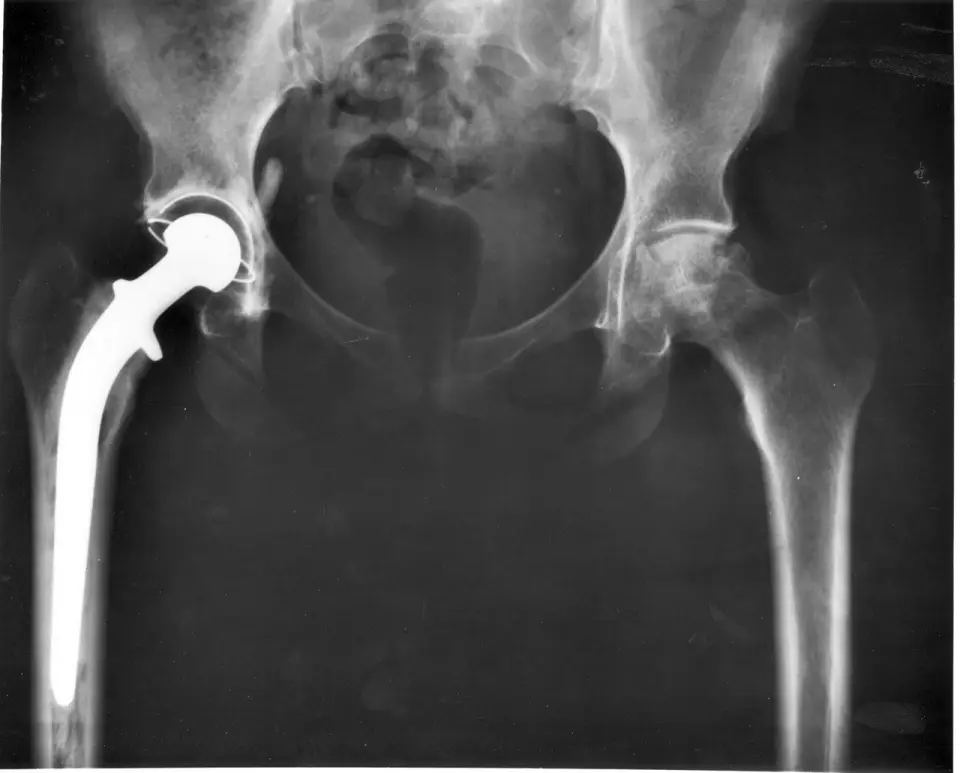
Padrão similar de migração de 2 anos para um desenho de tronco reduzido e distalmente reduzido na artroplastia total de quadril não cimentado: um ensaio controlado randomizado utilizando análise radioestereométrica
CirurgiaO que aconteceu
The primary objective was to compare subsidence and retroversion in the first 2 postoperative years of 2 uncemented hip stem designs in primary minimally invasive anterior-supine surgical (MIS-ASI) total hip arthroplasty: a shortened hip stem (Microplasty) and a standard-length stem with reduced distal width (Reduced Distal). Secondary objectives were to compare migration patterns, patient-reported outcome measures (PROMs), clinical and radiological scores, and the occurrence of (serious) adverse events up to 2 years postoperatively. 50 patients were randomized in this non-blinded, single-surgeon, industry-funded, radiostereometric analysis study (RSA) (ClinicalTrials.gov NCT03409666). Stem migration was measured relative to directly postoperative at 6 weeks, 1 year, and 2 years postoperatively, using model-based RSA. Linear mixed-effect modelling was used to compare migration. Primary outcomes were subsidence and retroversion at 2 years postoperatively. Secondary outcomes were migration, PROM questionnaires, clinical and radiological scores, and the presence of adverse events in the first 2 postoperative years.
Trecho mantido em inglês: a tradução automática não passou na conferência de números.
O que encontraram
Migration of 15 Microplasty and 20 Reduced Distal stems showed comparable initial migration between direct and 6 weeks postoperative RSA, stabilizing thereafter. Predominant migration directions were subsidence and retroversion with mean values at 2 years of 1.47 mm (95% confidence interval [CI] 0.32-2.61) and 2.57° (CI 1.64-3.50) for the Microplasty stem and 2.35 mm (CI 1.36-3.34) and 1.59° (CI 0.79-2.39) for the Reduced Distal stem. At 6 weeks postoperatively, posterior tilt about the medial-lateral axis was different between stem designs, with 0.07° (CI -0.27 to 0.40) for the Microplasty and 0.48° (CI 0.19-0.77) for the Reduced Distal designs. Secondary outcomes were not clinically different between the stem designs.
Trecho mantido em inglês: a tradução automática não passou na conferência de números.
Por que isso importa
Mostrou-se que a subsidência inicial e a retroversão para ambos os desenhos de hastes na cirurgia MIS-ASI estavam presentes, embora provavelmente não clinicamente relevantes. Não houve diferença estatisticamente significante na subsidência e retroversão entre os desenhos do tronco. Embora a migração inicial tenha variado substancialmente entre os pacientes e o desenho Reduced Distal mostrou maior inclinação posterior, ambos os desenhos mantiveram uma posição estável de 6 semanas a 2 anos de pós-operatório.
Tradução automática do resumo original, publicado em Acta orthopaedica sob licença CC BY. Os números são conferidos contra o original; siglas e termos técnicos podem variar.
O estudo original
Similar 2 year migration patterns for a shortened and a distally reduced stem design in uncemented total hip arthroplasty: a randomized controlled trial using radiostereometric analysis
Lennard A Koster, Bart Kaptein, Esmeralda Goorden, Constant A M P Bell, Rob G H H Nelissen
Descritores MeSH
- Prosthesis Design
- Prosthesis Failure
- Arthroplasty, Replacement, Hip
- Hip Prosthesis
- Male
- Middle Aged
- Patient Reported Outcome Measures
- Radiostereometric Analysis
- Aged
- Female