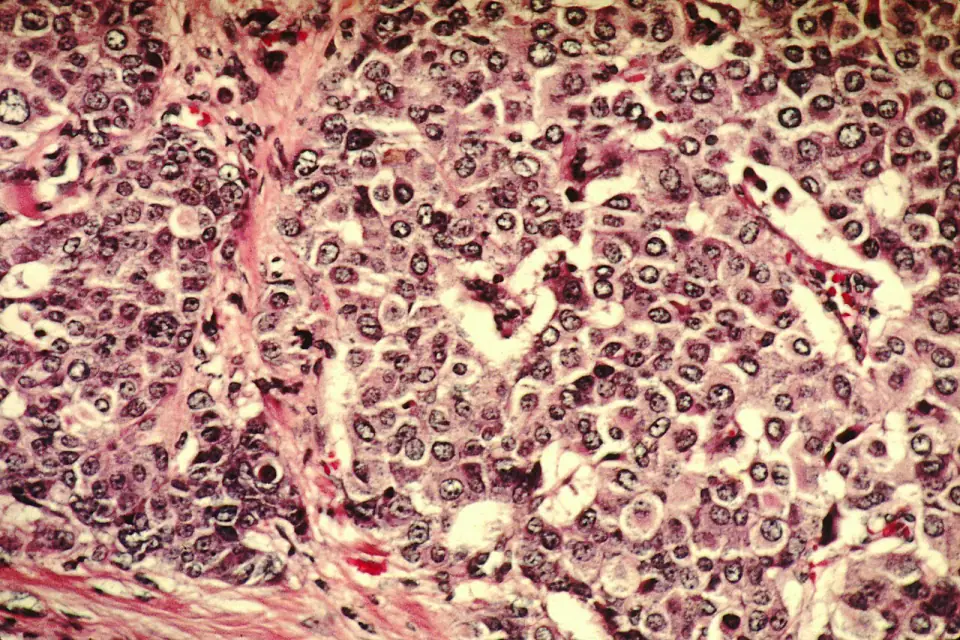
Expression- and splicing-based multi-tissue transcriptome-wide association studies identified multiple genes for breast cancer by estrogen-receptor status
OncologiaPor ScienceMed · · a partir do resumo dos autores
Resumo original em inglês
O que aconteceu
Although several transcriptome-wide association studies (TWASs) have been performed to identify genes associated with overall breast cancer (BC) risk, only a few TWAS have explored the differences in estrogen receptor-positive (ER+) and estrogen receptor-negative (ER-) breast cancer. Additionally, these studies were based on gene expression prediction models trained primarily in breast tissue, and they did not account for alternative splicing of genes.
In this study, we utilized two approaches to perform multi-tissue TWASs of breast cancer by ER subtype: (1) an expression-based TWAS that combined TWAS signals for each gene across multiple tissues and (2) a splicing-based TWAS that combined TWAS signals of all excised introns for each gene across tissues. To perform this TWAS, we utilized summary statistics for ER + BC from the Breast Cancer Association Consortium (BCAC) and for ER- BC from a meta-analysis of BCAC and the Consortium of Investigators of Modifiers of BRCA1 and BRCA2 (CIMBA).
O que encontraram
In total, we identified 230 genes in 86 loci that were associated with ER + BC and 66 genes in 29 loci that were associated with ER- BC at a Bonferroni threshold of significance. Of these genes, 2 genes associated with ER + BC at the 1q21.1 locus were located at least 1 Mb from published GWAS hits. For several well-studied tumor suppressor genes such as TP53 and CHEK2 which have historically been thought to impact BC risk through rare, penetrant mutations, we discovered that common variants, which modulate gene expression, may additionally contribute to ER + or ER- etiology.
Por que isso importa
Our study comprehensively examined how differences in common variation contribute to molecular differences between ER + and ER- BC and introduces a novel, splicing-based framework that can be used in future TWAS studies.
Resumo publicado sob licença CC BY. A tradução para o português ainda não chegou a este estudo.
O estudo original
Expression- and splicing-based multi-tissue transcriptome-wide association studies identified multiple genes for breast cancer by estrogen-receptor status
Julian C McClellan, James L Li, Guimin Gao, Dezheng Huo
Descritores MeSH
- Breast Neoplasms
- Estrogens
- Female
- Humans
- Receptors, Estrogen
- Genetic Predisposition to Disease
- Polymorphism, Single Nucleotide
- Genome-Wide Association Study
- Transcriptome
Veja também
Estudos relacionados
- Integração de GWAS e análise de células únicas para psoríase identifica subtipos celulares associados à doença e alvos terapêuticos
- Genetic associations with pulmonary embolism among those with a deep vein thrombosis: the International Network Against Venous Thrombosis Consortium
- Integrative genetic and liver transcriptomic analyses identify TRIB1AL as a target for steatotic liver disease
- Integrating cell-type-specific gene expression and genome-wide associations identifies risk genes for schizophrenia
- Multi-Ancestry integrativo e multi-tecido Fine-Mapping prioriza candidato genes causais para risco de câncer de mama e seus subtipos