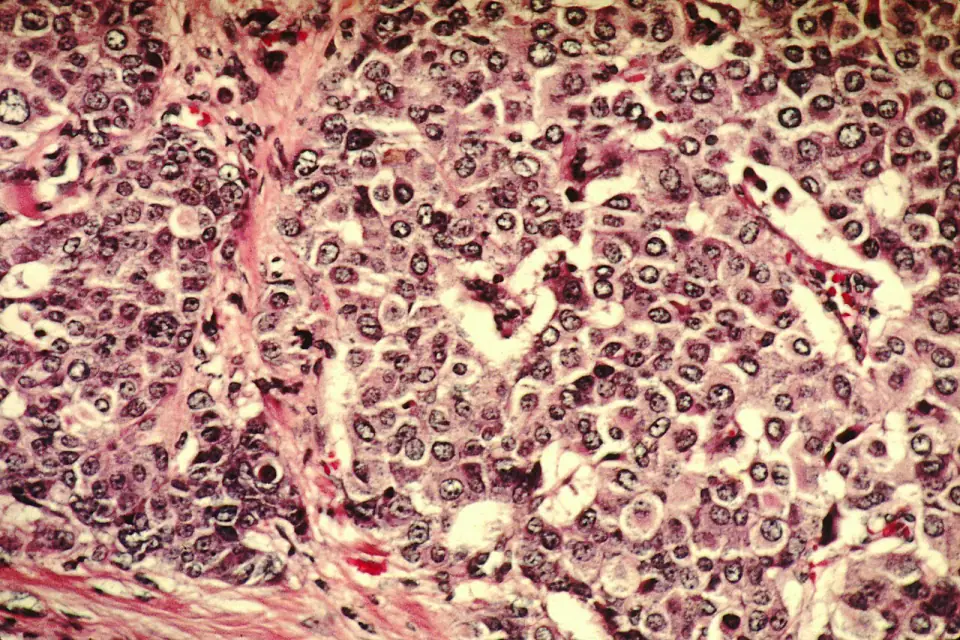
ESR1, PGR, ERBB2, and MKi67 mRNA expression in postmenopausal women with hormone receptor-positive early breast cancer: results from ABCSG Trial 6
OncologiaPor ScienceMed · · a partir do resumo dos autores
Resumo original em inglês
O que aconteceu
The purpose of this study was to assess the concordance of real-time quantitative reverse transcription polymerase chain reaction (RT-qPCR) detection of ESR1, PGR, ERBB2, and MKi67 messenger RNA (mRNA) in breast cancer tissues with central immunohistochemistry (IHC) in women treated within the prospective, randomized Austrian Breast and Colorectal Cancer Study Group (ABCSG) Trial 6.
We evaluated ESR1, PGR, ERBB2, and MKi67 mRNA expression by Xpert® Breast Cancer STRAT4 (enables cartridge-based RT-qPCR detection of mRNA in formalin-fixed paraffin-embedded tissues) and estrogen receptor (ER), progesterone receptor (PR), human epidermal growth factor receptor 2 (HER2), and Ki67 protein expression by IHC [in situ hybridization (ISH) for HER2 IHC 2+] in 1115 surgical formalin-fixed paraffin-embedded specimens from patients of ABCSG Trial 6. Overall percent agreement (concordance), positive percent agreement (sensitivity), and negative percent agreement (specificity) between STRAT4 and IHC were determined for each marker. The primary objective of the study was concordance between STRAT4 mRNA measurements of ESR1, PGR, ERBB2, and MKi67 with central reference laboratory IHC (and ISH for HER2 IHC 2+ cases). Time to distant recurrence was analyzed by Cox models.
O que encontraram
All performance targets for ER, PR, and Ki67 were met. For HER2, the negative percent agreement target but not the positive percent agreement target was met. Concordance between STRAT4 and IHC was 98.9% for ER, 89.9% for PR, 98.2% for HER2, and 84.8% for Ki67 (excluding intermediate IHC 10%-20% staining). In univariable and multivariable Cox regression analyses, all four biomarkers tested by either STRAT4 RT-qPCR or by central IHC (ISH) had a comparable time to distant recurrence indicating similar prognostic value.
Por que isso importa
With the exception of HER2, we demonstrate high concordance between centrally assessed IHC and mRNA measurements of ER, PR, and Ki67 as well as a high correlation of the two methods with clinical outcome. Thus, mRNA-based assessment by STRAT4 is a promising new tool for diagnostic and therapeutic decisions in breast cancer.
Resumo publicado sob licença CC BY. A tradução para o português ainda não chegou a este estudo.
O estudo original
ESR1, PGR, ERBB2, and MKi67 mRNA expression in postmenopausal women with hormone receptor-positive early breast cancer: results from ABCSG Trial 6
M Filipits, M Rudas, C F Singer, F Fitzal, Z Bago-Horvath, R. Greil, M Balic, S F Lax, S Halper, W Hulla et al.
Descritores MeSH
- Breast Neoplasms
- Receptors, Progesterone
- Hormones
- Humans
- Neoplasm Recurrence, Local
- Prospective Studies
- Estrogen Receptor alpha
- RNA, Messenger
- Biomarkers, Tumor
- Postmenopause
Veja também
Estudos relacionados
- ESR1, PGR, ERBB2, and MKi67 mRNA expression in diagnostic core biopsies from breast cancer patients of the ABCSG Trial 34
- Diffusion-Weighted MRI for the Assessment of Molecular Prognostic Biomarkers in Breast Cancer
- Diagnostic performance of ultrasound-based artificial intelligence for predicting key molecular markers in breast cancer: A systematic review and meta-analysis
- Associação do antígeno do câncer 15-3 com recorrência à distância em subtipos de câncer de mama imuno-histoquimicamente definidos no Canadian Cancer Trials Group MA.32