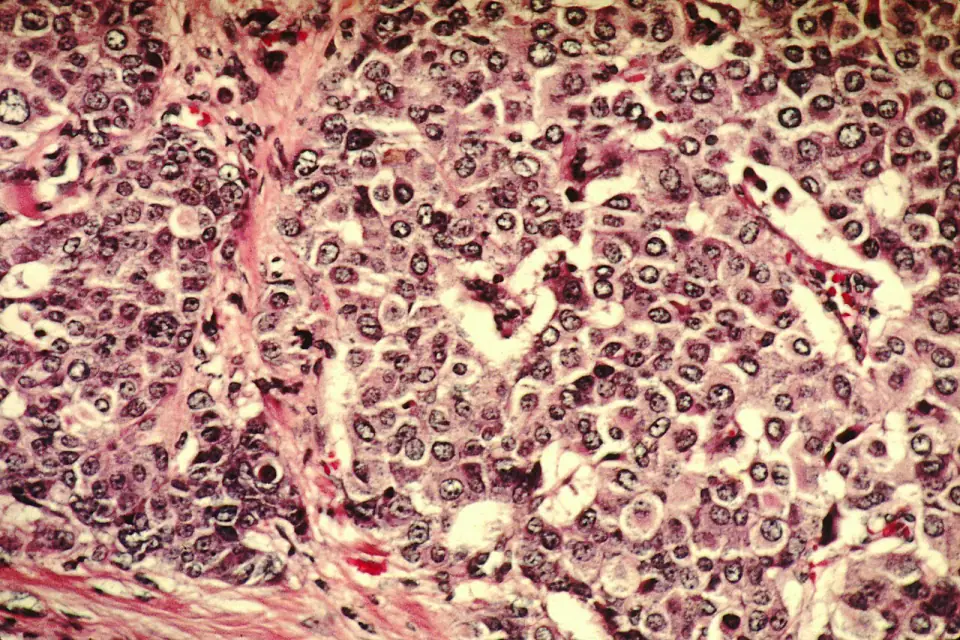
Benefício sustentado do olaparib adjuvante em mulheres com câncer da mama precoce HER2 negativo de alto risco associado à linha germinativa BRCA1 e BRCA2: resultados actualizados do ensaio de fase III de OlympiA
OncologiaPor ScienceMed · · · a partir do resumo dos autores
Resumo original em inglês
O que aconteceu
The randomised phase III OlympiA trial (NCT02032823) compared 1 year of adjuvant olaparib [oral poly (ADP-ribose) polymerase inhibitor] with placebo in 1836 patients with pathogenic/likely pathogenic BRCA1 or BRCA2 [germline BRCA pathogenic variants (gBRCApvs)] germline variants and high-risk human epidermal growth factor receptor 2 (HER2)-negative early breast cancer (BC). Previous interim analyses (IAs) demonstrated statistically significant improvements in invasive disease-free survival (IDFS), distant disease-free survival (DDFS) and overall survival (OS), irrespective of hormone receptor status, prior platinum administration, timing of prior chemotherapy or type of gBRCApv. Herein are the results of the third prespecified IA with a median follow-up (MFU) of 6.1 years.
Descriptive analyses are presented for the primary endpoint IDFS and key secondary endpoints of DDFS and OS. Estimates of the hazard ratio (HR) based on the stratified Cox's proportional hazards model and 95% confidence intervals (CIs) are presented with yearly event rates at an MFU of ≤6.1 years. Safety analyses included adverse events of special interest (AESIs).
O que encontraram
Olaparib benefits were maintained in IDFS (HR 0.65, 95% CI 0.53-0.78), DDFS (HR 0.65, 95% CI 0.53-0.81) and OS (HR 0.72, 95% CI 0.56-0.93). The 6-year OS for olaparib versus placebo was 87.5% versus 83.2% (difference 4.4%, 95% CI 0.9% to 6.7%). Olaparib benefit was consistent across all key subgroups, including patients with high-risk hormone receptor-positive disease. There were fewer BRCA-associated new BC and ovarian/fallopian tube cancer cases and there was no increase in AESI risks (6.3% versus 9.3%), including myelodysplastic syndrome (MDS)/acute myeloid leukaemia (AML) (0.4% versus 0.7%), with olaparib versus placebo.
Por que isso importa
At an MFU of 6.1 years, 1 year of adjuvant olaparib after (neo)adjuvant chemotherapy demonstrated ongoing clinically meaningful improvements in IDFS, DDFS and OS in patients with gBRCApvs and high-risk, HER2-negative early BC, with acceptable toxicity and without increased risk of MDS/AML. These data continue to provide support for adjuvant olaparib in the treatment of gBRCApv-associated high-risk, HER2-negative early BC.
Resumo publicado sob licença CC BY. A tradução para o português ainda não chegou a este estudo.
O estudo original
Sustained benefit of adjuvant olaparib in women with germline BRCA1- and BRCA2-associated high-risk HER2-negative early breast cancer: updated results from the OlympiA phase III trial
J E Garber, D Cameron, C Campbell, G Yothers, M Taboada, S El-Abed, P. Rastogi, R McConnell, A Correa, S Delaloge et al.
Descritores MeSH
- BRCA2 Protein
- Breast Neoplasms
- Phthalazines
- Piperazines
- BRCA1 Protein
- Poly(ADP-ribose) Polymerase Inhibitors
- Middle Aged
- Disease-Free Survival
- Erb-b2 Receptor Tyrosine Kinases
- Chemotherapy, Adjuvant
Veja também
Estudos relacionados
- Adjuvant Olaparib for Patients with BRCA1- or BRCA2-Mutated Breast Cancer
- Adjuvant PARP Inhibitors in Patients With High-Risk Early-Stage HER2-Negative Breast Cancer and Germline BRCA Mutations: ASCO Hereditary Breast Cancer Guideline Rapid Recommendation Update
- Ensaio de fase 2 randomizado de um inibidor de PARP TSL-1502 em câncer de mama germinativo com mutação BRCA, HER2-negativo localmente avançado/metastático
- Targeting homologous recombination deficiency with intensified chemotherapy versus standard chemotherapy followed by olaparib in stage III breast cancer (SUBITO): an open-label, randomised, controlled, phase 3 trial
- Incidence of myelodysplastic syndrome and acute myeloid leukemia in patients receiving poly-ADP ribose polymerase inhibitors for the treatment of solid tumors: A meta-analysis of randomized trials
- A phase III trial of adjuvant ribociclib plus endocrine therapy versus endocrine therapy alone in patients with HR-positive/HER2-negative early breast cancer: final invasive disease-free survival results from the NATALEE trial