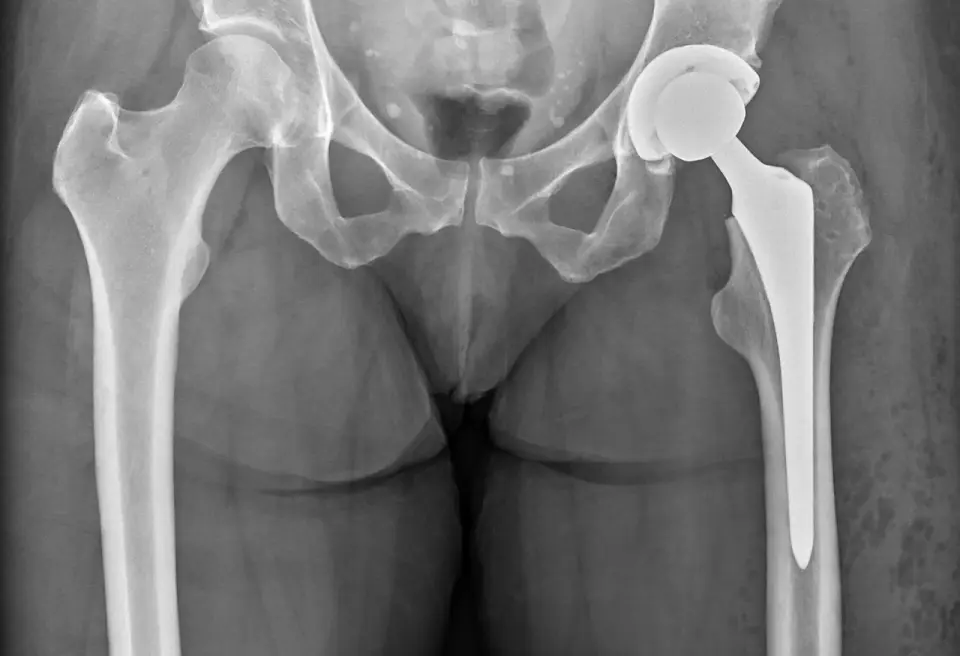
Artroplastia total do quadril em dupla mobilidade vs. hemiartroplastia bipolar no tratamento de pacientes com fratura do colo femoral deslocada: revisão sistemática e meta-análise
OrtopediaPor ScienceMed · · · a partir do resumo dos autores
Resumo original em inglês
O que aconteceu
Total hip arthroplasty (THA) has been reported with superior outcomes in hip pain, reoperation rate, function, but higher rate of dislocation compared with bipolar hemiarthroplasty (BHA) for treatment of displaced femoral neck fractures (DFNFs). A dual mobility cup (DMC) has been designed to reduce the rates of dislocation and re-operation. However, whether DMC-THA achieves better clinical outcomes than BHA remains ambiguous. Therefore, we have conducted this meta-analysis to investigate the clinical outcomes of DMC-THA vs. BHA in the treatment of DFNFs.
We identified studies in the following electronic databases, Medline, Embase, the Cochrane Library, and Web of Science before December 2025. The Preferred Reporting Items for Systematic reviews and Meta-Analysis (PRISMA) guidelines were strictly followed. We performed our research using Review Manager 5.4 software. This study was prospectively registered in INPLASY (registration number: INPLASY202040085; DOI: 10.37766/inplasy2020.4.0085).
O que encontraram
Sixteen studies were eligible for the present meta-analysis, which enrolled 1,296 patients undergoing DMC-THA and 1,208 patients undergoing BHA. Compared with patients undergoing BHA, those undergoing DMC-THA showed significantly lower rates of dislocation (P < 0.00001), reoperation (P = 0.0004), one-year mortality (P < 0.0001), and last follow-up mortality (P = 0.01), along with higher Harris Hip Scores (HHS) (P = 0.001). However, the DMC-THA group ha d a longer operative time (P < 0.00001). No statistical differences were found in 1-month mortality (P = 0.29), 3-month mortality (P = 0.09), transfusion rate (P = 0.68), infection rate (P = 0.71), fracture (P = 0.81), loosening of components (P = 0.46), thromboembolism (P = 0.10), heterotopic ossification (P = 0.06), and hospitalization period (P = 0.22) between DMC-THA and BHA.
Por que isso importa
DMC-THA may be associated with lower rates of dislocation, reoperation, and mortality compared with BHA in the treatment of DFNFs. However, given the predominantly observational nature of the included studies, these findings do not establish a definitive causal relationship. While DMC-THA is associated with a longer operative time, it does not appear to increase the risk of complications such as transfusion, infection, fracture, or thromboembolism. However, the evidence supporting these findings remains limited, and DMC-THA should be considered a potential treatment option rather than a routinely recommended approach for DFNFs. More high-quality studies with large sample sizes, adequate follow-up periods, and standardized outcome reporting are needed to further validate the long-term efficacy and safety of DMC-THA relative to BHA.
Resumo publicado sob licença CC BY. A tradução para o português ainda não chegou a este estudo.
O estudo original
Dual mobility total hip arthroplasty vs. bipolar hemiarthroplasty in treating patients with displaced femoral neck fractures: a systematic review and meta-analysis
Weichao Wang, Ziang Cheng, Keteng Xu, Fuqing Lin, Qing Yan
Descritores MeSH
- Femoral Neck Fractures
- Arthroplasty, Replacement, Hip
- Hemiarthroplasty
- Proximal Femoral Fractures
- Treatment Outcome
- Reoperation
- Humans
- Postoperative Complications
Veja também
Estudos relacionados
- Intraoperative acetabular periprosthetic fracture (IAPF) in total hip arthroplasty: a systematic review of outcomes and complications in conservative and surgical treatment
- Effectiveness of open reduction internal fixation versus revision arthroplasty around Vancouver type B2 periprosthetic femoral fractures: a systematic review and meta-analysis
- Comparison of complications between total hip arthroplasty following failed internal fixation and primary total hip arthroplasty for femoral neck fractures: A meta-analysis
- Surgical approaches for inserting hemiarthroplasty of the hip in people with hip fractures